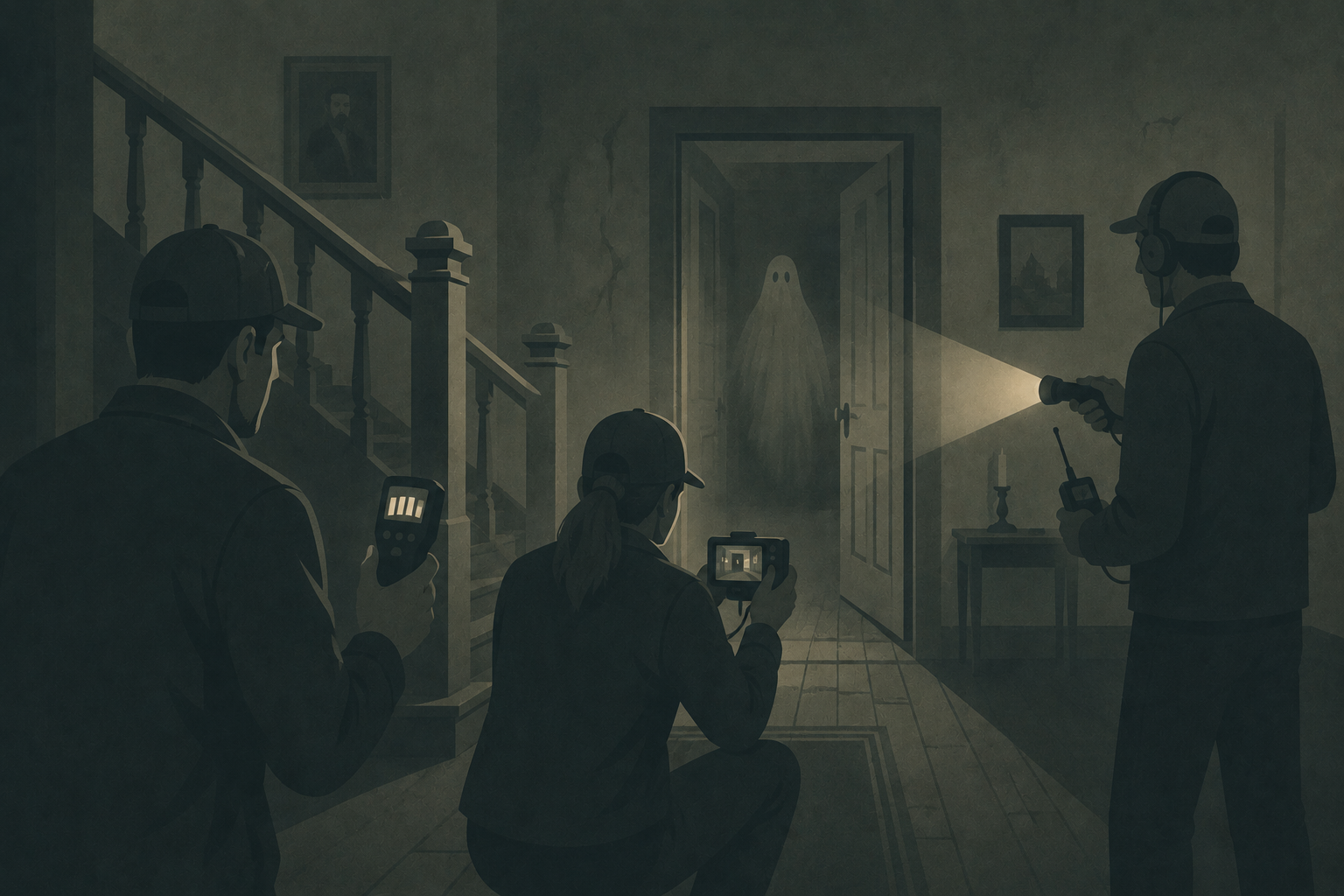
The pursuit of the spectral is perhaps the oldest and most enduring human endeavor. From the shamanistic rituals of ancient tribes attempting to commune with ancestors to the modern-day "ghost hunter" armed with thermal cameras and EMF meters, we have never been able to accept the finality of death. We are driven by a desperate, insatiable curiosity to know if the consciousness survives the biological vessel. Ghost hunting is not merely a hobby; it is a modern quest to bridge the gap between the living and the dead, a technological séance conducted in the dark corners of our history. It is a discipline that sits on the razor's edge of science and superstition, requiring both rigorous data collection and a willingness to believe in the impossible.
To understand the methodology of ghost hunting, one must first understand the theoretical framework of the paranormal. The most widely accepted model, often referred to as "The Intelligence Theory," posits that a spirit or consciousness can manifest itself in our reality by interacting with the physical environment. This interaction requires energy. It is hypothesized that the spirit uses electromagnetic fields (EMF) to manipulate matter or project a presence. This is why ghost hunters obsess over EMF meters. When the needle jumps erratically in a supposedly empty room, it is not just a fluctuation in the grid; it is the signal of a presence. The spirit is not just a ghost; it is a dynamic force, a consciousness that can manipulate the very fabric of our reality to get our attention.
The tools of the trade have evolved dramatically from the Ouija boards and planchets of the Victorian era. Today, the ghost hunter is a technologist of the unseen. We use Digital Voice Recorders (DVRs) to capture Electronic Voice Phenomena (EVP). These are voices or sounds that are not heard by the human ear in real-time but are captured on digital audio files. The speculation here is that the audio spectrum is wider than we perceive, and spirits can speak in frequencies that bypass our biological hearing. When we listen back to hours of static in a dark room, hoping to hear a name, a date, or a whisper, we are engaging in a form of digital archaeology. We are digging through the noise of the universe to find the signal of the past.
We also rely heavily on photography and video. While skeptics will point to lens flares and lens spots, the true believer sees a different story. Anomalies that appear in photos—orbs, streaks of light, or figures that seem to defy physics—are viewed as photographic evidence of the spirit realm. The "orb" is the most debated phenomenon. Is it dust? Moisture? Or is it the energy of a soul captured in a moment of transition? The speculation is that the camera lens, which is sensitive to a wider range of light than the human eye, captures the "aura" or the electromagnetic signature of a spirit. We are essentially taking snapshots of the veil between worlds.
The process of investigation is as much psychological as it is technological. A good ghost hunt begins with a thorough investigation of the history of the location. Every old house has a story—a tragedy, a murder, a sudden death. The ghost is often said to be tied to a specific event, a "residual haunting" where the past replayed itself like a looped video. The investigator must become a historian, piecing together the timeline of the property to understand who might be there. We walk the perimeter, check for drafts (which could be cold spots caused by a spirit dissipating heat), and set up a "base camp" to monitor the environment. We wait. We listen. We breathe in the stale air of a place where history has settled.
The most compelling aspect of ghost hunting is the sensory experience. It is a realm of the unknown, where the familiar rules of physics seem to bend. There is the "feeling of being watched," a primal instinct that is often triggered in supposedly haunted locations. There are the sudden drops in temperature, known as "cold spots," which are believed to be the spirit drawing energy from the surrounding air. There are the phantom footsteps, the slamming doors, and the feeling of a cold hand on the shoulder. These are not just tricks of the mind; they are the tangible evidence of a reality we cannot see.
However, the skeptic in all of us must also acknowledge the limitations of the science. Pareidolia—the human tendency to perceive meaningful patterns in random noise—is a powerful psychological phenomenon. We want to see faces in the smoke; we want to hear words in the static. We are hardwired to find patterns. But to dismiss the entire phenomenon as hallucination is to close the door on a vast, unexplored reality. The fact that so many independent investigations across the globe yield similar results suggests that there is something real happening. It is not a matter of if ghosts exist, but rather of what they are and how they communicate.
The future of ghost hunting lies in the convergence of technology and intuition. We are moving toward using artificial intelligence to analyze the massive amounts of data we collect—audio files, thermal images, and sensor readings. We are looking for patterns that the human brain cannot process. We are trying to quantify the unquantifiable. But ultimately, ghost hunting is a human endeavor. It is driven by our fear of death and our hope for connection. We are searching for proof that we are not alone, that our loved ones are still here, watching over us, waiting for us to notice them.
The hunt is a spiritual exercise as much as a scientific one. It requires an open mind and a respectful attitude toward the spirits we encounter. We are not just trespassers in these places; we are guests in their history. When we ask questions into the dark, we are engaging in a dialogue with the past. Whether we get an answer or not, the act of asking changes us. It forces us to confront our own mortality and to appreciate the fragility of life. The ghost hunter is a seeker, a wanderer in the liminal space between the living and the dead. We are the ones who go into the dark so that the rest of the world can sleep soundly, safe in the knowledge that the spirits are real.