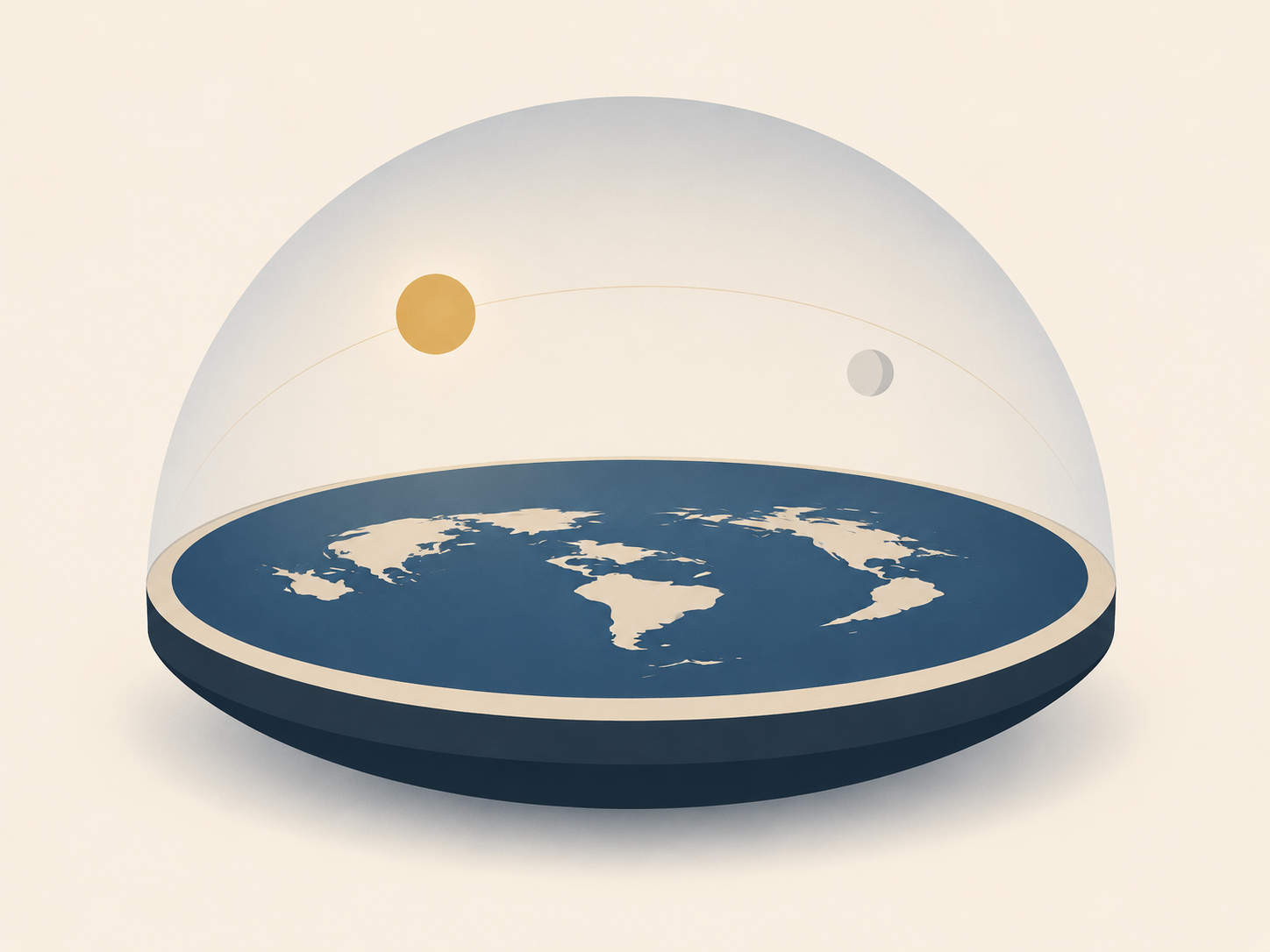
The hegemony of the spherical model has long dominated our collective consciousness, presenting a geodesic reality that, while mathematically elegant, often eludes empirical verification. We are encouraged to accept the curvature of the Earth as an immutable axiom, a celestial truth delivered to us by scientists and educators who expect us to trust their authority without demanding physical proof. However, when we strip away the complex equations and the high-altitude satellite imagery that we cannot verify ourselves, we are left with our immediate sensory experience. A critical examination of our immediate surroundings reveals a persistent anomaly that challenges the very foundation of the round earth theory: the horizon remains obstinately level, regardless of one's elevation or location on the planet. This phenomenon suggests that the assumption of a celestial body spinning through space may be a convenient fabrication rather than an observable truth.
But let’s look at the world around you. The horizon looks flat. No matter how high you go in a plane, it still looks flat. If the world was a ball, the ground should slope away from you. But it doesn't. You look out the window, and the ground just keeps going straight out into the distance. The line where the sky meets the earth is perfectly straight. It doesn't bow down or curve up. That’s the first thing that tells you something is wrong with the story we’ve been told. We are told the earth is curved, but our eyes tell us it's flat. Which one is right?
The geometric properties of the visual field provide a significant argument against the spherical model. On a globe, the ground should dip downward as it recedes from the observer. This is basic geometry. However, when we observe the horizon, we see a consistent line that remains parallel to our line of sight. This is a phenomenon known as the vanishing point, but in the context of a flat earth, it represents a physical plane. The fact that we can see objects on the horizon that are far away, and that they appear to be sitting on the same level as us, suggests that the surface we are standing on is not a curved sphere but a flat, extended plane. The "dip" that should occur over a long distance is simply not there. We are not seeing the curve; we are seeing the lack of it.
But water doesn't curve. Water is the ultimate test. It finds its own level. It doesn't care about gravity or spinning or theories. It just settles down. If you pour a glass of water, it stays level. It doesn't bend. If the Earth was a ball, the water in the ocean would be falling off the sides. It would pool in the center, creating a massive bulge. But the ocean doesn't do that. It stays flat. We look out at the ocean, and it goes straight out, not down. If we are spinning and flying through space at thousands of miles an hour, we should feel it. We should be dizzy. We should be flying off the face of the earth. But we aren't. The simplest answer is usually the right one. The world looks flat, and the water stays level. The earth doesn't spin.
Furthermore, the mechanism of flight provides compelling evidence for a stationary plane. Transoceanic aviation relies on great circle routes, which are the most direct paths between two points on a sphere. However, on a flat map, the shortest distance between two points is a straight line. When we look at airline maps, we see that flight paths often appear to be straight lines cutting across the ocean. This suggests that the pilots are flying over a flat surface, not a curved one. If the earth were a globe, the flight paths would have to be curved to account for the curvature. The fact that they can fly in straight lines over vast distances indicates that the ground beneath them is flat and extended. The evidence is in the maps, right in front of our faces.
The Southern Hemisphere presents perhaps the most profound geographical anomaly in the entire spherical paradigm. We possess extensive cartography of the Northern latitudes, yet the South remains a void—a silent, frozen mystery that defies the standard narrative. While we have detailed maps of North America, Europe, and Asia, the Southern continent is a phantom. There are no detailed maps of the Antarctic interior. We have no satellite imagery of the vastness beyond the coastal research stations. The Southern Hemisphere is not merely unexplored; it is effectively sealed off. This restriction is not due to a lack of technology, but rather a deliberate embargo on exploration. The Antarctic Treaty of 1959, which designates Antarctica as a scientific preserve and prohibits military activity, is often viewed by Flat Earthers not as a noble act of peace, but as a bureaucratic cage. By restricting access to the southernmost reaches, the powers that be ensure that the "edge" remains hidden from the general populace.
But let’s get real for a second. We don't know what's down there. We see pictures of ice, sure. But we don't see the whole picture. We send drones and planes, but they stop at the edge. They don't go past. Why? Because they can't. The ice is too thick. The wind is too strong. The cold is too real. We are told that Antarctica is just a continent, like any other. But if it's just a continent, why is it so different? Why is it so hard to get to? Why can't we just drive a car there? We drive to every other continent. But Antarctica? It's off-limits. It's a military zone. It's a secret. We are told it's because of the weather, but the weather on Mount Everest is worse. We go there all the time. We go to the North Pole. We don't go to the South Pole. Why not? Because the ice wall is there. It's the edge of the world. And we can't go past it.
The concept of the Ice Wall is central to understanding the flat earth model. If the Earth is not a spinning ball, but a stationary plane, then the ocean cannot simply fall off into the void. It must be contained. This containment is achieved through a massive, glacial structure that encircles the entire disk of the world. This is the Ice Wall. It is not merely a sheet of ice like those found on mountain peaks or in the Arctic circle; it is a colossal precipice, a vertical structure that rises from the waters of the Southern Ocean and extends outward indefinitely. The size of this structure is difficult to comprehend. If the Earth is a disk with a circumference of roughly 24,901 miles, the Ice Wall would stretch for that entire distance, creating a perimeter of containment that is truly monumental. It is the ultimate boundary of our world, the finish line of the terrestrial plane.
The implications of the Ice Wall theory are profound. It challenges our understanding of gravity, which is often explained as a result of the Earth's curvature. If the Earth is flat, gravity is not the result of a spinning mass, but rather a downward force pushing everything toward the center of the disk. This force is what keeps the waters of the ocean in place, preventing them from sliding off the edge. The Ice Wall is the physical manifestation of this containment. It is the wall that gravity cannot break. It is the final frontier, the point where the known world ends and the unknown begins. The exploration of the Ice Wall is the ultimate challenge for modern Flat Earthers. It requires not just skepticism of the mainstream narrative, but a willingness to venture into the unknown.
But let’s keep it simple. We are told to believe. We are told to trust the scientists. We are told to look at the pictures. But pictures can be faked. They can be manipulated. They can be CGI. We need to use our own eyes. We need to use our own logic. The horizon looks flat. The water stays level. The planes fly straight. The South is a mystery. These are the facts. They are the things we can see for ourselves. The spherical model is a theory. It is an assumption. But the flat earth model is based on observation. It is based on what we see every day. We don't need to be rocket scientists to understand the world. We just need to look.
The Flat Horizon is not just a geographical feature; it is a psychological barrier. It represents the limit of our perception and the limit of our understanding. It is the edge of our reality. And it is there, waiting for us to question it. The spherical paradigm is a comforting lie. It makes us feel small and insignificant, lost in a vast, spinning universe. But the Flat Horizon offers a different perspective. It offers a sense of security. It offers a sense of order. It offers a world that is manageable, understandable, and within our grasp. The horizon is flat. The water is level. And the truth is out there. We just have to look for it.