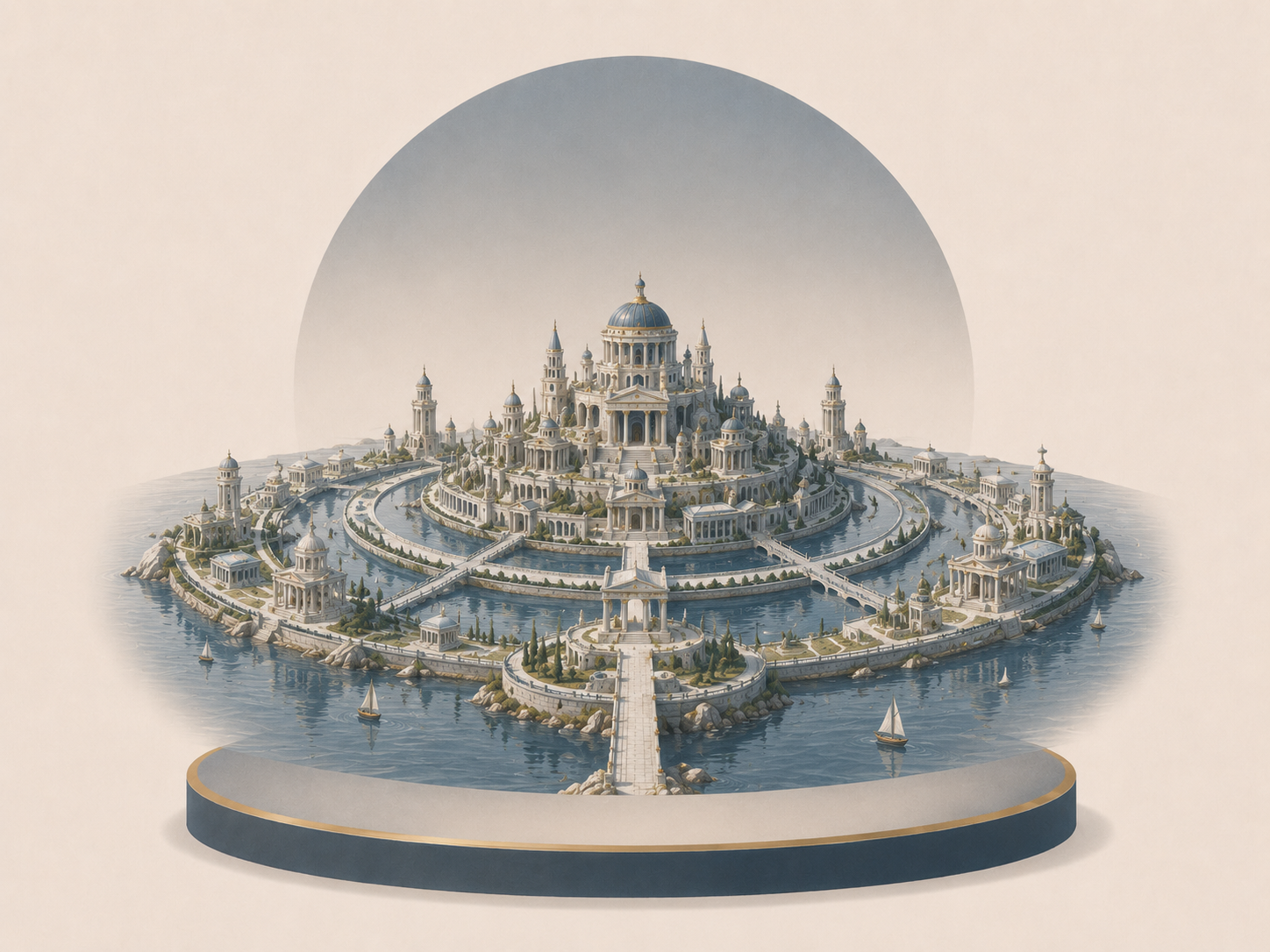
The hegemony of Western history has long been anchored by the writings of Plato, the Athenian philosopher who, in his dialogues Timaeus and Critias, first introduced the world to the legend of Atlantis. For over two millennia, this story has captivated the human imagination, serving as the archetype for the "lost golden age"—a civilization of immense power, technological sophistication, and eventual tragic downfall. However, as we move beyond the classical narrative, the speculation regarding Atlantis becomes a sprawling labyrinth of geographical hypotheses, geological theories, and esoteric interpretations. To explore these theories is to question not just where the city might have been, but what it represents in the collective psyche of humanity and whether our world has a hidden history that we have yet to uncover.
The original account provided by Plato, dating back to approximately 360 BC, describes Atlantis as a naval power located "in front of the Pillars of Hercules," which we now recognize as the Strait of Gibraltar. According to the story, the Atlanteans possessed a utopian society governed by laws and living in harmony until their lust for conquest led them to war with ancient Athens. The conflict ended when the gods, displeased by the Atlanteans' hubris, sent a cataclysmic deluge that submerged the island continent in a single day and night. This narrative serves as a moral warning about the dangers of overreaching ambition—a theme that resonates deeply across cultures and epochs. Yet, for millennia, this remained a philosophical allegory for Plato. It was not until the 19th century that the search for Atlantis shifted from philosophy to archaeology.
The most scientifically grounded, yet still speculative, theory posits that Atlantis was actually the island of Thera, now known as Santorini, in the Aegean Sea. This theory gained traction in the mid-20th century following the discovery of the Minoan civilization on the nearby island of Crete. The Minoans were a sophisticated seafaring people who possessed advanced architecture, plumbing, and art, suggesting a civilization comparable to what Plato described. The catastrophic eruption of the Thera volcano around 1600 BC, which devastated the island and caused massive tsunamis that likely struck the coast of Crete, aligns suspiciously well with Plato's description of a sudden destruction by fire and water. The circular island with concentric rings of water and land, which Plato detailed in his account, is said to match the caldera of the volcano. While the timeline is debated—with Plato claiming Atlantis existed 9,000 years before his time, while geological evidence suggests the eruption occurred much more recently—the structural similarities are undeniable. This theory transforms Atlantis from a myth into a historical memory of a real, devastating geological event.
However, if we look beyond the Mediterranean, the speculative possibilities expand into the realms of the bizarre and the extraordinary. One of the most fascinating, albeit controversial, theories places Atlantis in the Antarctic continent. This theory relies on the concept of "pole shift"—the idea that the Earth's axis has shifted dramatically in the past, moving continents from tropical zones to polar ones. Proponents of this view argue that Atlantis could not have existed in the frozen wasteland we know today, but must have been located in a warmer climate. If the North Pole was once in the Pacific Ocean, or if the South Pole was once tropical, then Antarctica becomes a prime candidate for the location of a high-tech civilization. This theory is often linked to the "Ice Wall" concept, suggesting that the frozen barrier at the bottom of the world is not just ice, but the lid of a lost world. The idea of a civilization thriving in a tropical Antarctica before a pole shift destroyed it and froze it over is a captivating one, though it requires a significant reimagining of geological history.
Moving across the Atlantic, another prominent theory suggests that Atlantis was located in the Caribbean Sea, specifically near the Bahamas. The "Bimini Road"—a submerged rock formation off the coast of North Bimini—is the focal point of this hypothesis. The road appears to be a man-made pathway of large stones arranged in a straight line, leading many to speculate that it is the remains of a port or a breakwater from the ancient city. The legend of "New Atlantis" was even used by Sir Francis Bacon in the 17th century as a utopian vision for a new society. While most geologists argue that the Bimini Road is a natural limestone formation, the persistence of the theory speaks to the human desire to find evidence of advanced civilizations in the Western Hemisphere. This theory implies that the ancient Atlanteans were global navigators, capable of crossing the ocean to establish colonies in the New World.
Further south, the Sahara Desert presents another intriguing possibility. The Sahara is the largest hot desert in the world, yet geological evidence shows that it was once a lush, green savannah teeming with wildlife and human settlements. Some theorists speculate that Atlantis was located in what is now the middle of the Sahara, submerged beneath the vast desert sands after the climate changed. The presence of ancient megalithic structures, such as the Giza pyramids, which some argue predate the accepted dynastic Egyptian period, adds fuel to this fire. If a civilization existed in North Africa that was advanced enough to rival the Egyptians, and if it was wiped out by a sudden climate shift, the memory of that civilization could have been carried across the Mediterranean and transformed into the myth of Atlantis. This theory highlights the fragility of human civilization and the speed at which nature can reclaim its territory.
Beyond geographical speculation, there is the esoteric and spiritual interpretation of Atlantis. In this view, Atlantis was not a physical place, but a state of consciousness—a Golden Age of human potential. The theory posits that the Atlanteans possessed psychic abilities, advanced healing technologies, and a deep connection to the Earth and the cosmos. The destruction of Atlantis was not a geological event, but a spiritual one—a fall from grace caused by misuse of energy and technology. This perspective transforms the legend into a metaphor for the evolution of the human soul. It suggests that we are currently in a "New Atlantis," a time of rebirth and awakening, where humanity is rediscovering the lost knowledge of the past. This theory is popular in New Age circles and offers a comforting narrative of hope and spiritual progress.
The implications of discovering Atlantis are profound. It would validate the existence of a high-tech civilization that predates known history, forcing us to rewrite the timeline of human development. It would suggest that we are not the first species to reach the stars, nor the first to master the elements. The discovery would also have psychological implications, offering a tangible connection to a time when humanity lived in harmony with the earth and with itself. However, the absence of physical evidence for Atlantis keeps it firmly in the realm of speculation. The myths persist because they resonate with our deepest fears and desires. We fear the loss of knowledge, the collapse of civilization, and the annihilation of the natural world. We desire a lost paradise, a time when humanity was more advanced, more connected, and more powerful.
But let’s look at the practical side of this. Why do we keep looking? Because we are scared. We are scared that we are destroying ourselves. We are scared that we are going to lose everything. Atlantis is the symbol of what we could be. It’s the symbol of a time when we knew better. When we didn't pollute the rivers or burn the forests. When we had flying machines and healing crystals. It’s a mirror. When we look for Atlantis, we are really looking for ourselves. We are looking for a way to fix the mess we’ve made.
The theories of Atlantis are a testament to the human spirit. They are a testament to our refusal to accept the limits of our knowledge. They are a testament to our desire to believe that there is more to the world than what we see with our eyes. Whether Atlantis was in the Mediterranean, the Antarctic, the Caribbean, or the Sahara, or whether it was a metaphor for a lost state of mind, the legend continues to inspire. It inspires scientists to explore the depths of the ocean. It inspires explorers to search the deserts. It inspires dreamers to look up at the stars. The search for Atlantis is a search for the truth. And the truth, as Plato knew, is often stranger than fiction.
Ultimately, the mystery of Atlantis is a mystery of memory. It is the memory of a time when the world was young and the gods walked among men. It is the memory of a civilization that rose to greatness and fell into the dust. And it is the memory of a hope that we can rise again. The story of Atlantis is not just about a lost city; it is about the lost potential of humanity. It is about the possibility that we can create a paradise on Earth, if only we learn from the mistakes of the past. The search for Atlantis is a search for that paradise. And until we find it, the legend will live on, waiting for us to wake up and remember.