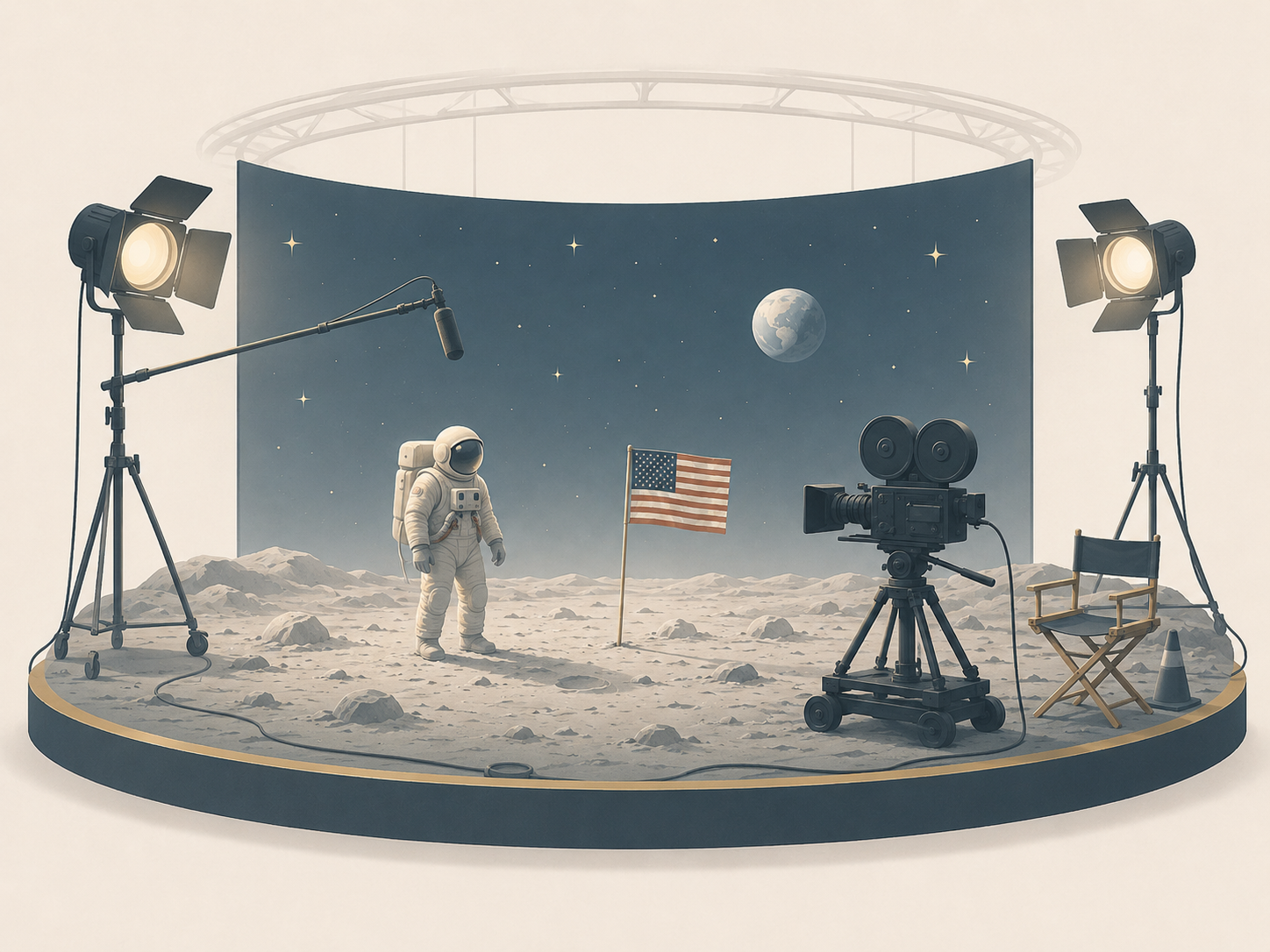
The hegemony of the spherical model has long dominated our collective consciousness, presenting a geodesic reality that, while mathematically elegant, often eludes empirical verification. However, when we shift our perspective to the Flat Earth model, the narrative of the Moon landing transforms from a triumph of human ingenuity into a colossal logistical absurdity. In this flattened paradigm, the Moon is not a celestial body orbiting a planet, but a giant light hanging suspended in the firmament, much closer to the surface than we are led to believe. The consequence of this perspective is that the Apollo missions were not explorations of the cosmos, but rather elaborate stagecraft designed to maintain the illusion of a round world. To accept the Flat Earth model is to accept that the Moon landing was a fabrication, and the consequences of this lie extend far beyond the launchpad, painting a picture of a reality constructed by Hollywood and maintained by a desperate need to obscure the truth.
But let’s look at the mechanics of this lie. If the Earth is a flat disc and the sky is a dome, the Moon is just a light hanging above us. It’s not 238,000 miles away; it’s much closer, perhaps just a few thousand miles up. The consequences of faking this are mind-boggling. You can’t just build a soundstage big enough to hold a Moon landing and hope no one notices. The scale of the deception is staggering. You have to fake the vacuum, the lack of atmosphere, and the lighting conditions. You have to convince the entire world that you traveled to a place that doesn't exist.
The Flat Earth Society has long argued that the Moon landing was staged by NASA, possibly with the aid of other organizations like Walt Disney, utilizing a script by Arthur C. Clarke and directed by Stanley Kubrick.1 This isn't just a theory; it's a necessary conclusion based on the model of the world they believe in. If you can't fly through the firmament, you can't go to the Moon. Therefore, the Moon landing had to be faked.2 The absurdity lies in the sheer scale of the conspiracy. It implies that every government, every scientist, every photographer, and every citizen of the 1960s was complicit in a lie of this magnitude. The consequences of maintaining this lie are that we are all living in a painted world, where the sky is a backdrop and the stars are merely lights in a projector.
Imagine the scene. You are Neil Armstrong, and you need to stand on the Moon. But the Moon isn't a rock in space; it's a giant light on the ceiling of the universe. If you believe the Flat Earth model, you don't need a rocket to get there. You need a ladder. A really, really long ladder. You need to climb the side of the firmament until you reach the underside of the Moon. And once you get there, you need to hold on tight. Because if you let go, you fall back to Earth.
This is where the absurdity truly takes hold. In the official narrative, astronauts use suction cups and adhesive tapes to move around on the lunar surface. But in a Flat Earth context, they are actually climbing the dome. Imagine the logistics of this mission. You have to build a ladder that reaches thousands of miles into the sky. You have to carry it all the way to Antarctica, the edge of the world. Then you start climbing. And climbing. And climbing. You pass through the clouds. You pass through the upper atmosphere. And then, finally, you reach the firmament. And there it is—the Moon, hanging just above you like a giant lightbulb. You strap on your suction cups. You grab onto the glass of the sky. You pull yourself up. You sit on top of the Moon. And then you take a picture.
The consequences of this fake landing are visible in the very footage we were given. Look at the photos from the Apollo missions. There are no stars in the sky. This is a common argument against the Moon landing, but in the Flat Earth context, it makes perfect sense. If the Moon is just a light on the dome, and the Earth is a flat disc, then the stars are just lights in a backdrop. The backdrop was painted in a studio. The artists didn't paint stars because they didn't want to give away the location of the set. The light from the Sun in outer space is at least as bright as the sunlight that reaches the Earth's surface on a clear day at noon, so cameras used for imaging subjects illuminated by sunlight are set for a daylight exposure.1 The dim light of the stars simply does not provide enough exposure to record visible images in this artificial setting. The lack of stars isn't a technical glitch; it's a tell. It's a sign that the photo was taken against a wall, not in space.
Furthermore, consider the physics of the dust. The conspiracy theorists argue that the dust kicked up by the astronauts' boots and the wheels of the Lunar Roving Vehicles rose quite high due to the lower lunar gravity, and it settled quickly to the ground in an uninterrupted parabolic arc since there was no air to suspend it.1 Even if there had been a sound stage for hoax Moon landings that had the air pumped out, the dust would have reached nowhere near the height and trajectory as in the Apollo film footage because of Earth's greater gravity.1 This suggests that the footage wasn't filmed in a studio with Earth gravity. It was filmed where the gravity was low. But if the Earth is flat, where is this low gravity? It's on the other side of the dome. So, the fake landing wasn't filmed in a Hollywood studio; it was filmed on the other side of the firmament. This means that NASA didn't just fake the Moon landing; they built a set on the Moon. And that is a consequence of the lie that is even more absurd than the idea of climbing the dome with suction cups.
The consequences of this lie extend beyond the physics of dust and the absence of stars. They reach into the very fabric of our trust in institutions. When we accept the Flat Earth model, we reject the scientific method as we know it. We reject the idea that evidence should be tested with fair experiments that are designed to put hypotheses to the most stringent tests possible.3 Instead, we embrace a worldview where the evidence is manufactured. We accept that the consensus of the scientific community is a result of propaganda, not discovery. The Moon landing is the Rosetta Stone of conspiracy theories. It is the key that unlocks the door to all other lies.2 Once you believe that the Moon landing was faked, it becomes easy to believe that the Earth is flat, that the government is hiding the truth about aliens, and that 9/11 was an inside job.
But let’s get back to the absurdity. The consequences of faking the Moon landing are that we are all living in a cartoon. The sky is a dome. The stars are lights. The Moon is a prop. And we are all just trying to figure out how to climb the wall. The idea of astronauts strapping on suction cups to climb the side of the firmament is the ultimate image of the Flat Earth dream. It’s a dream of discovery, but it’s also a dream of desperation. We want to know what’s out there. We want to know if there’s more land beyond the ice wall. But we can’t get there because we are trapped under the dome. And the only way to escape is to climb the wall.
The consequences of this lie are that we are small. We are trapped on a disc in the middle of a void. And the only thing that separates us from the unknown is a thin layer of ice and a glass ceiling. The Moon landing was an attempt to make us feel big. It was an attempt to make us feel like explorers. But in the Flat Earth model, it was just a puppet show. And the consequences of that puppet show are that we are still looking up, wondering if there is anyone out there, or if we are just alone in a painted room. The suction cups are ready. The ladder is built. We just need to take the first step.
The Flat Earth model is not just a theory about geography; it is a theory about power. It is a theory that says the people in charge are lying to us. And the Moon landing is the ultimate proof of that lie. It is the ultimate evidence that the truth is stranger than fiction. The consequences of this lie are that we are all living in a world of our own making, a world that is beautiful, but also a world that is fake. And the only way to find the real world is to climb the wall. To climb the ice wall. To climb the firmament. To climb the Moon. And to find out what’s on the other side.
The consequences of faking the Moon landing are not just about the past. They are about the future. They are about the next generation of explorers. If we believe the lie, we will never go to the Moon. We will never go to Mars. We will never go anywhere. We will just stay on the disc, looking up at the painted sky. But if we reject the lie, if we reject the spherical model, if we accept the Flat Earth model, then we have a new mission. We have a new goal. We have to climb the wall. We have to climb the dome. We have to find the edge. And we have to find out what’s really out there.
The consequences of this lie are that we are trapped. We are trapped in a narrative that we cannot escape. We are trapped in a story that we are told is true. But if we look at the evidence, if we look at the horizon, if we look at the stars, we see that the story is false. The Moon landing was a fake. The Earth is flat. And the only way to break free is to climb the wall. To climb the ice wall. To climb the firmament. To climb the Moon. And to find out what’s on the other side.