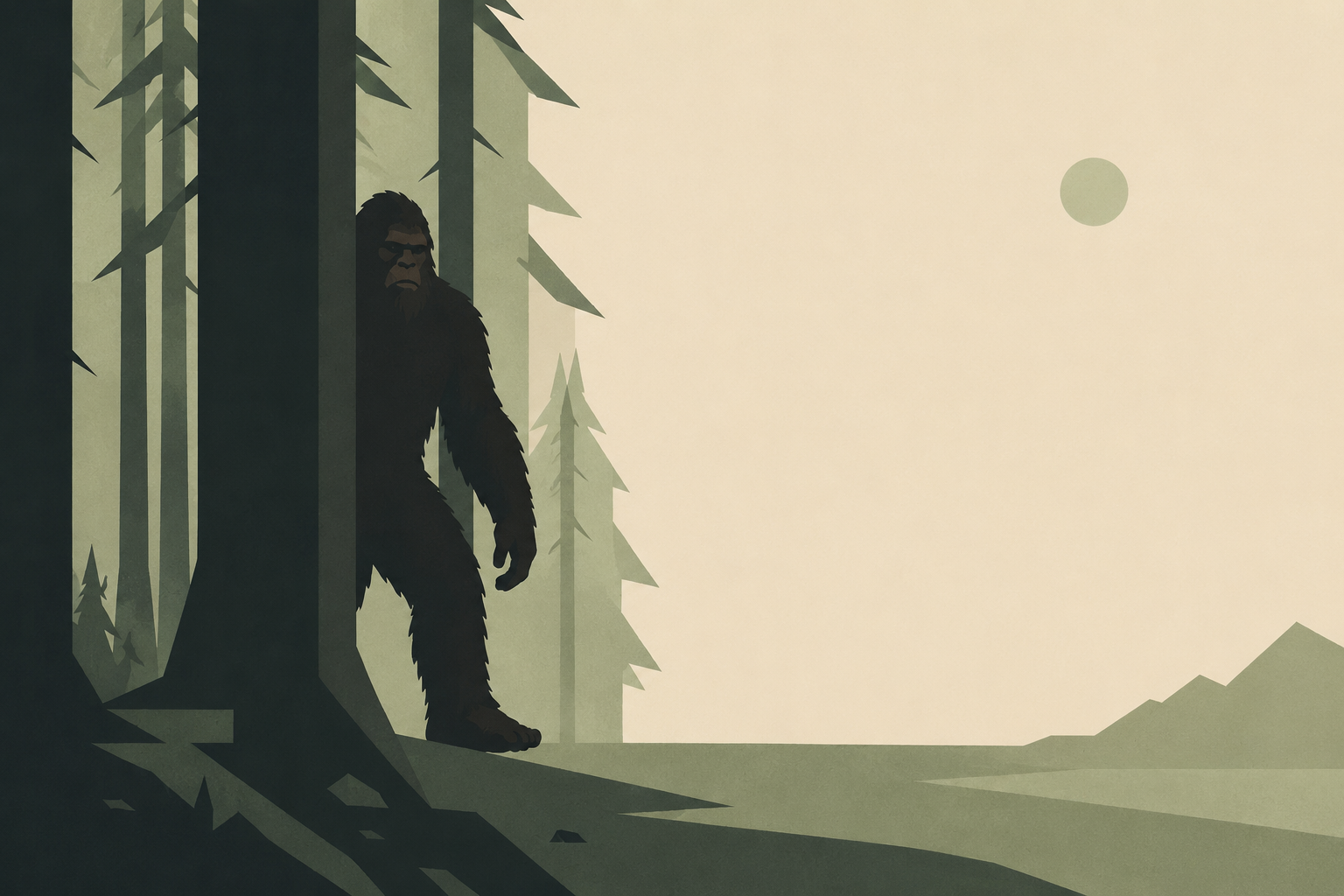
The enduring mystery of Sasquatch, or Bigfoot, represents one of the most profound anomalies in the landscape of human folklore and cryptozoology. For centuries, indigenous cultures across North America have spoken of a hairy, bipedal giant that dwells in the deepest recesses of the wilderness. From the legends of the Salish people to the oral histories of the Halkomelem, the creature has been a fixture of the collective imagination. However, the persistence of these stories has evolved beyond mere mythology into a serious biological hypothesis. The question is no longer whether these creatures exist, but rather what they are, how they have survived the encroachment of modern civilization, and what their existence would reveal about the hidden corners of our planet.
The hypothesis that a large, primate-like hominid resides in the North American wilderness is grounded in a convergence of anecdotal evidence, physical artifacts, and biological plausibility. The creature is typically described as standing between six and ten feet tall, covered in hair ranging from dark brown to black, with a distinctive musky odor. Most significantly, the creature is bipedal, walking upright on two legs with a gait that is often described as a shuffle or a strut. This bipedalism is the smoking gun for cryptozoologists, as it suggests a creature with an evolutionary lineage closely related to humans, yet distinct enough to have remained hidden from standard zoological scrutiny. The existence of such a creature would imply that the tree of human evolution is not a straight line converging on a single species, but a complex branching structure with many dead ends and hidden branches that we have yet to discover.
The most compelling body of evidence for Bigfoot is the physical footprint. Over the years, countless casts have been taken from deep in the woods, revealing footprints that are far too large and structured to be the work of a bear. The arch of the foot is high, and the toes are aligned in a human-like fashion. These footprints often show signs of pressure ridges and skin texture, suggesting they were made by a living, breathing animal. While skeptics argue that these footprints could be hoaxes, the sheer volume and variety of tracks found over decades make a universal hoax implausible. The consistency of the anatomy—length, width, and depth—points to a single species or a closely related family. The implication is that there is a population, likely large enough to maintain genetic diversity, that has evaded detection.
The auditory evidence is equally compelling. Dozens of witnesses have reported hearing guttural roars, whistles, and screams emanating from the forests at night. These sounds are not the calls of any known North American animal. They are low-frequency vocalizations that can travel long distances, suggesting a sophisticated communication system. If Bigfoot is a social creature, it requires a complex language to coordinate activities, warn of danger, and perhaps attract mates. The ability to vocalize at such low frequencies is a trait shared by elephants and whales, suggesting a level of intelligence that challenges our understanding of the forest ecosystem. The woods are not silent; they are alive with a language we do not yet understand.
From a biological perspective, the existence of Bigfoot is not impossible; it is merely difficult to explain. Evolutionary biology suggests that large-bodied animals require massive amounts of food to sustain their metabolism. If Bigfoot is a primate, it would need a diet rich in fruits, nuts, and vegetation, supplemented by protein from fish or small game. The Pacific Northwest, with its temperate rainforests, offers a seemingly ideal habitat. The region is teeming with resources, providing ample food and cover. The creature's ability to remain hidden is likely a result of extreme intelligence. They are not merely reacting to their environment; they are anticipating it. They know where humans go, when they go, and how to avoid them. This behavioral plasticity is a hallmark of highly adaptable species.
Furthermore, the concept of a "missing link" is often invoked to explain Bigfoot. The theory suggests that the creature is a relic population of Gigantopithecus, an extinct ape that lived in Asia millions of years ago. Some researchers propose that Gigantopithecus crossed the Bering Land Bridge during the last Ice Age and colonized North America. This theory is speculative, as no direct skeletal evidence of Bigfoot has been recovered. However, the genetic markers found in alleged Bigfoot hair and blood samples have shown anomalies that do not match known species, fueling the hope that DNA testing will eventually provide concrete proof. The existence of a living, breathing Gigantopithecus would rewrite the history of primates and force us to reconsider the timeline of human evolution.
The implications of discovering Bigfoot extend far beyond the realm of biology. It would validate the indigenous oral traditions that have been dismissed by Western science for generations. It would confirm that there are still vast, unexplored regions of the planet that harbor life forms unknown to modern taxonomy. The discovery would also have profound psychological and cultural implications. Bigfoot represents the ultimate symbol of the wild—the untamed, primal force that exists on the fringes of human civilization. The idea of a giant, hairy hominid lurking in the shadows appeals to our deep-seated fear of the unknown and our desire to believe that nature still holds secrets.
But let’s look at the reality. We go into the woods. We hike the trails. We use GPS and night vision goggles. And we still don't find them. The woods are getting smaller. The cities are getting bigger. Where are they hiding? It’s not just about the deep forest anymore. They have to be smart. They have to be fast. They have to know how to live with us, even if they don't like us. Maybe they aren't hiding in the deep woods. Maybe they are living in the suburbs. Maybe they are the reason we see deer in our backyards. Maybe they are the reason the raccoons are so bold. They are the invisible neighbors we never see.
The technology is getting better. Drones are flying over the trees. Cameras are everywhere. In the future, we will find them. We have to. The question isn't if they exist. The question is when we will finally see them face to face. It’s going to be a moment that changes everything. We will look at a video and see a face. We will see a baby. We will see a family. We will realize that we aren't alone. We aren't the only ones on this rock. There are others. And they have been watching us for a long time.
The mystery of Bigfoot is a mirror. It reflects our own fears and our own desires. We are afraid of the dark. We are afraid of the unknown. But we also want to believe in something bigger than ourselves. We want to believe that there is magic in the world. We want to believe that the stories our grandparents told us were true. Bigfoot is the bridge between the old world and the new world. It is the reminder that nature is still wild. It is the reminder that we haven't conquered everything. The woods are still out there. And they are full of secrets.
In conclusion, the speculation surrounding Bigfoot is a testament to the enduring power of the unknown. Whether they are a relic of the past, a hidden species of primate, or a trick of the light, the legend persists. It persists because it challenges our understanding of the world. It forces us to question the limits of our knowledge. And it keeps us looking up, looking out, and listening to the silence of the woods. The shadow in the woods is still there. And one day, it will step into the light. And we will finally know the truth.